Cisitalia 202: the sculpture in motion that changed automotive design
In 1946, a coachbuilding project born in Turin anticipated a new idea of the automobile. The Cisitalia 202 did not seek a spectacular effect through ornamentation: it made the continuity of surfaces and the balance of proportions its own language. Its history runs through Italian craftsmanship, the Museum of Modern Art in New York and, today, Pininfarina Heritage collectible objects.
There are automobiles that tell the story of an era. And there are some that help change the way it is designed. The Cisitalia 202 belongs to the second category. Observing it, the naturalness of its profile strikes you: the hood, fenders, cabin and tail seem to belong to a single form, rather than a sum of components. It is precisely this quality that makes it relevant, even many decades later.
A new idea of the automobile in post-war Italy
The Cisitalia 202 was born in the climate of reconstruction following World War II. Italian industry was seeking new directions, and artisanal coachbuilding was still a place where technique and stylistic experimentation directly met. In this context, Battista “Pinin” Farina's vision proposed an automobile capable of expressing modernity without resorting to excessive decoration.
The Museum of Modern Art dates the Cisitalia 202 GT project to 1946; Pininfarina's product sheets dedicated to the Berlinetta refer to the 1947 model. These are two complementary dates, not an inconsistency: one concerns the stylistic conception, the other the period in which the car takes the form with which it is commonly remembered. However, to understand the importance of the 202, it is not enough to place it on a timeline. It is necessary to look at how it was designed.
The revolution of continuous form
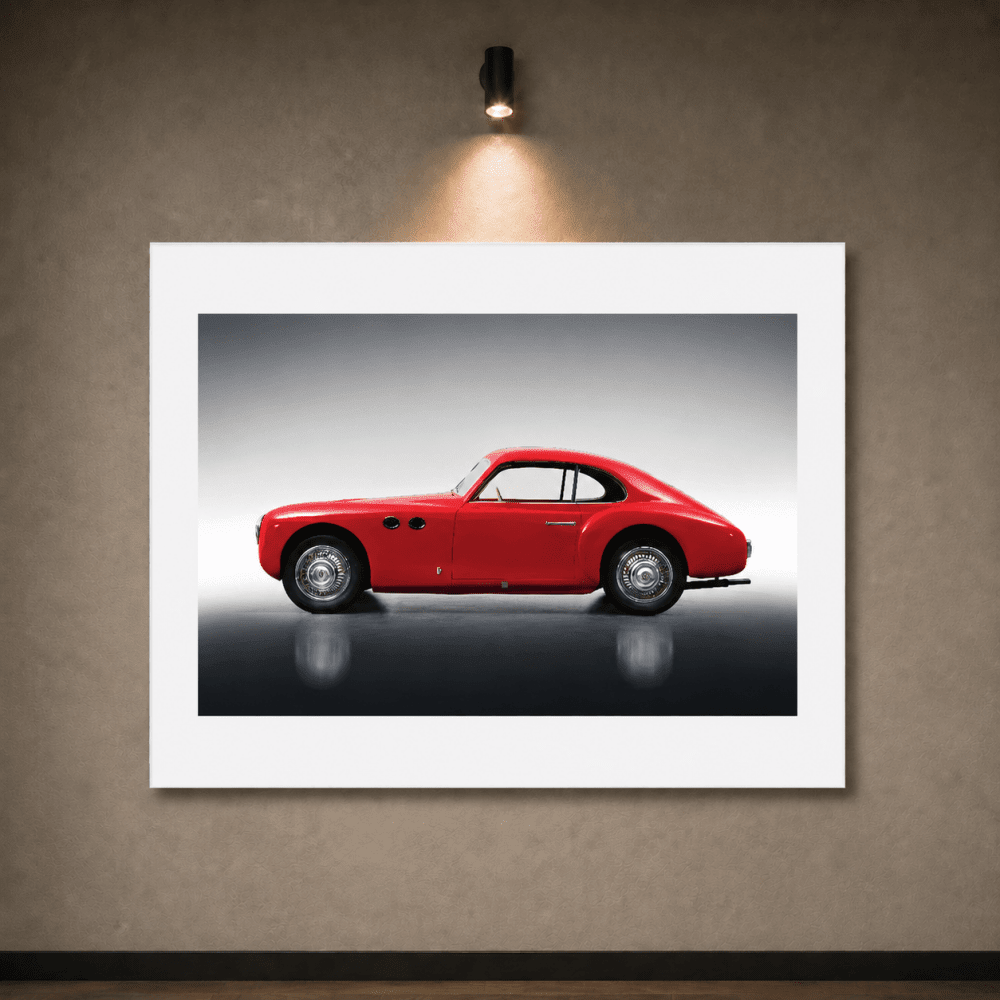
In automobiles from an earlier era, the fenders could appear as elements separate from the central body, the running boards interrupted the volume, and numerous chrome details highlighted the individual parts. The Cisitalia 202 changes the point of view. Its elements are joined, the surface is stretched, and the profile gains immediate readability.
A recognizable profile without the need for excess
The roofline guides the eye toward the tail, while the hood and the side participate in the same composition. This does not mean that the car gives up its personality: on the contrary, it achieves it through restraint. Proportions become character, continuity becomes elegance, and the design communicates movement even when the car is stationary.
This is a lesson that transcends the automotive sector. A well-designed object does not necessarily have to show all the work it contains. When every formal choice finds a reason, the result can appear simple. Simplicity, in this case, is not an absence of design: it is its most refined outcome.

Craftsmanship and innovation: the hand-built bodywork
The fluidity of the Cisitalia was not just an idea on paper. It had to be translated into material using the available techniques. According to MoMA documentation, the aluminum body panels were hammered and shaped over wooden forms, according to a practice inherited from the tradition of coachbuilders. It was therefore not the automated production that would become common in mass series.
This process required manual sensitivity, control of curvatures, and the ability to interpret a drawing in three dimensions. Every surface had to dialogue with those nearby. Artisanal construction contributed to the quality of the result, but also limited its spread: MoMA indicates about 170 known examples, a figure that makes it evident how far the 202 was from the rhythms of mass production.
The most interesting fact is not rarity itself. It is the relationship between the artisan's gesture and the designer's vision. The Cisitalia demonstrates that an innovative form can be born from the combination of different skills, when the execution does not limit itself to repeating the project, but precisely interprets its intentions.
From the garage to the museum: why the Cisitalia 202 is at MoMA
In 1972, the Cisitalia 202 entered the collection of the Museum of Modern Art in New York: it is the first automobile acquired by the museum. The transition is significant because it recognizes in the automobile a cultural dignity that goes beyond its use as a means of transport. The industrial object becomes a subject of study for those who deal with architecture, art, and design.
The museum sheet identifies the car as the Cisitalia 202 GT Car, attributed to Battista “Pinin” Farina, with aluminum bodywork. The famous expression “sculpture in motion,” associated with its critical success, summarizes the reason for so much interest: not just a machine capable of moving, but a form designed to evoke movement through design.
Presence at MoMA does not automatically transform every automobile into a work of art. However, it makes evident that design can also be evaluated for its ability to innovate the language of everyday objects. The 202 occupies a special place precisely because it moved the boundary between engineering, craftsmanship, and visual culture.

A heritage that continues to speak through drawings
A photograph shows the result; a sketch can help understand the process. In the design sheets, proportions are not yet just a silhouette to admire: they become relationships between volumes, views, axes, and measurements. This is why the archive of a design house has a value that does not end in nostalgia. It preserves the way an idea took shape.
The Pininfarina Heritage – Cisitalia 202 SK collection reproduces an original pencil study from 1947, preserved in the Pininfarina archive. The composition allows you to observe the car through multiple views and to focus on the relationships between the parts. It is a choice suitable for those who love design as a discipline, not just as an aesthetic result.
Another interpretation is the Heritage ST print, dedicated to the side view and the iconic presence of the car. The Heritage DETT print instead enhances the historical photograph. They are different ways of telling the same subject: the project, the completed form, and visual memory.
What distinguishes a Heritage print from a simple reproduction?
The official sheets indicate Fine Art prints on 250 g myPur Coton paper, with a certificate of authenticity and dedicated editorial materials. It is important to distinguish the original archive work from the contemporary print: the latter is not the unique historical drawing, but a reproduction designed to make that heritage accessible and enhance it. The frame is not included in the viewed versions.
The Cisitalia 202 in cedar: design to be observed up close
The story of a coachbuilt car can also be told in three dimensions, without resorting to a full-size automobile. Two models of the Cisitalia 202 Berlinetta are available in the official shop, both in scented cedar and in limited editions: the 1:10 scale and the 1:18 scale.
The choice of wood introduces an interesting contrast. An automobile born from the meeting of metal and aerodynamic research is interpreted through a natural material, with its own grains and tones. The model does not claim to reproduce the mechanical complexity of the car: it focuses attention on the volume, the silhouette, and the ability of the profile to remain recognizable even at a reduced scale.

Scale 1:10 or 1:18: which interpretation to choose?
The 1:10 scale provides a greater presence and invites you to calmly observe the relationship between the hood, roof, and tail. The 1:18 is more compact and can fit discreetly in a bookcase, on a shelf, or in a study. It is not a difference in historical value: both are contemporary interpretations of the same icon. The choice depends on the space and the way you wish to display the object.

From car design to personal space: why this story is still relevant
The charm of the Cisitalia 202 is not limited to those who collect automobiles. An architect can read its relationship between volumes, a designer can recognize the discipline of the surfaces, an industrial history enthusiast can rediscover the value of Italian craftsmanship. In each of these perspectives, there is a common element: curiosity about objects capable of bringing together function and beauty.
Bringing a print or a model of the Cisitalia into a work environment means choosing a precise cultural reference. Not just a decorative object, but a silent reminder: innovating does not necessarily mean adding. Sometimes it consists in removing what interrupts the coherence of a form, until what truly matters emerges.
It is a continuity found in Pininfarina's history, from special coachbuilt cars to other sectors of contemporary design. To retrace this evolution, the official Pininfarina Heritage timeline is available. The Cisitalia 202 is one of its most eloquent chapters: an object born in its own time, but not remaining a prisoner of its era.
Frequently asked questions about the Pininfarina Cisitalia 202
In what year was the Cisitalia 202 designed?
MoMA dates the Cisitalia 202 GT project to 1946. Pininfarina's product sheets inspired by the Berlinetta refer to 1947. The distinction reflects the different phases of the model's history.
Why is the Cisitalia 202 considered important for design?
For the continuity of the bodywork and the reduction of separate and decorative elements. Its form anticipates a more unified language, in which the hood, fenders, cabin, and tail participate in a coherent composition.
Is the Cisitalia 202 really part of the MoMA collection?
Yes. The Museum of Modern Art in New York confirms that the Cisitalia 202 was the first automobile acquired in its collection, in 1972. The artwork sheet can be viewed online.
What is the difference between the Pininfarina Heritage SK, ST, and DETT prints?
SK enhances a pencil study with technical views; ST offers a representation of the silhouette; DETT is dedicated to an archival photograph. The exact characteristics and available measurements are indicated in their respective product sheets.
Are the Cisitalia 202 models in the shop made of metal?
No. The official models currently available in the viewed sheets are made of scented cedar wood, in scales 1:10 and 1:18. They are collectible objects inspired by the historic car, not functional mechanical reproductions.
Official sources and further reading
The historical reconstruction is based on the Pininfarina Heritage page and the MoMA Cisitalia 202 GT sheet. The characteristics of the prints and models are verified in the official sheets of Heritage SK, Heritage ST, Heritage DETT, model 1:10 and model 1:18. Availability and configurations may vary over time.