Battista Pinin Farina: from 1930 to the Florida II, the birth of a timeless style
A design story can begin with a coachbuilding company, but continue for generations through ideas, materials, and very different objects. This is the case of Battista “Pinin” Farina, founder in 1930 of the Carrozzeria Pinin Farina in Turin. His entrepreneurial project was born from excellence in craftsmanship and already looked toward industrial production: a balance between a special piece and a vision of the future that would define the company's identity.
To understand this story, it is not enough to observe the most famous automobiles. One must read the less obvious passages: the choice of aerodynamics when the car was still a privilege, the dialogue with international car manufacturers, the search for essential surfaces, and the role of the archive in making that visual culture accessible today.
Turin, 1930: the birth of an idea
On May 22, 1930, the Società Anonima Carrozzeria Pinin Farina was founded. According to the official timeline, the factory on Corso Trapani occupied 9,250 square meters and employed 150 people. Its activity was dedicated to the design and construction of special bodies for individual clients or small series.
These data tell an interesting productive tension. On one hand, the tradition of bespoke coachbuilding: every client, every chassis, every proportion required attention. On the other, Battista's conviction that the automobile would overcome the elitist dimension to become an important tool of individual mobility.
For this reason, the birth of Pinin Farina should not be read merely as the founding of a style laboratory. It is also the start of a way of conceiving design as an encounter between aesthetic vision, technical knowledge, and industrial organization.
Why aerodynamics changes the language of the automobile
From decorated coachwork to coherent form
In the 1930s, when automobiles often retained a clear distinction between hood, cabin, fenders, and accessories, Pinin identified aerodynamics as a way to define a new formal identity. It was not just a matter of reducing air resistance: movement could become a quality perceptible even when the vehicle was stationary.
Design thus began to seek greater continuity between parts. Volumes, surfaces, and lines were not independent elements, but components of a readable whole. This research anticipates a principle that is still relevant today: a convincing form does not need to explain every detail, because it communicates through proportions.
Experimentation as a method
The official Pininfarina Heritage page recalls the early aerodynamic research, including the aerodynamic Alfa Romeo 6C Pescara Coupé presented in 1935. The interest in innovation did not erase the artisanal dimension, but expanded its possibilities.
Cadillac V16, 1931: the encounter between America and Italy
One of the most eloquent chapters of the initial phase is the 1931 Cadillac V16, described by the official shop as the company's first project carried out on a non-Italian chassis. The coachwork brings American mechanics into dialogue with Italian stylistic sensibility, at a time when the boundaries of luxury automobiles were still strongly linked to national traditions.
The project, inspired by the sports roadsters of the era, had an apparently two-seater configuration but was capable of accommodating two other seats hidden in the rear. This particular is significant: the elegance of the proportions coexisted with a functional solution designed for real use.

The Cadillac V16 Heritage print allows us to observe this season through an archival image presented as a collectible object. It is not a simple decorative element: it is a way to preserve and reread a passage of design history.
From pre-war research to the post-war period
The world conflict interrupted industrial relations and developments, but not the direction of research. In the post-war period, the ability to transform an automobile into a unitary composition of surfaces became increasingly recognizable. The 1946 Cisitalia represents a famous milestone, already explored in another article on this blog: here we are especially interested in the method that made its birth possible.
The decisive step is the continuity between technique and aesthetics. Form must not hide the architecture of the vehicle, but interpret it. The designer does not intervene only at the end to make a mechanical solution more pleasant: they participate in the construction of its identity.
Lancia Flaminia Florida II: the design Battista chose for himself
In 1957 the Lancia Flaminia Florida II, presented at the Geneva Motor Show, becomes another reference of Pininfarina's research. Its significance is not only historical: the car was chosen by Battista “Pinin” Farina as a personal automobile, a fact remembered in the official Heritage print sheets.
Clean surfaces, proportions, and comfort
The Florida II highlights a more essential conception of the profile, with attention to the continuity of the glass and bodywork, the design of the rear, and the comfort of the passengers. These are characteristics that make us understand how much the automotive project had evolved compared to the special coachwork of the 1930s.

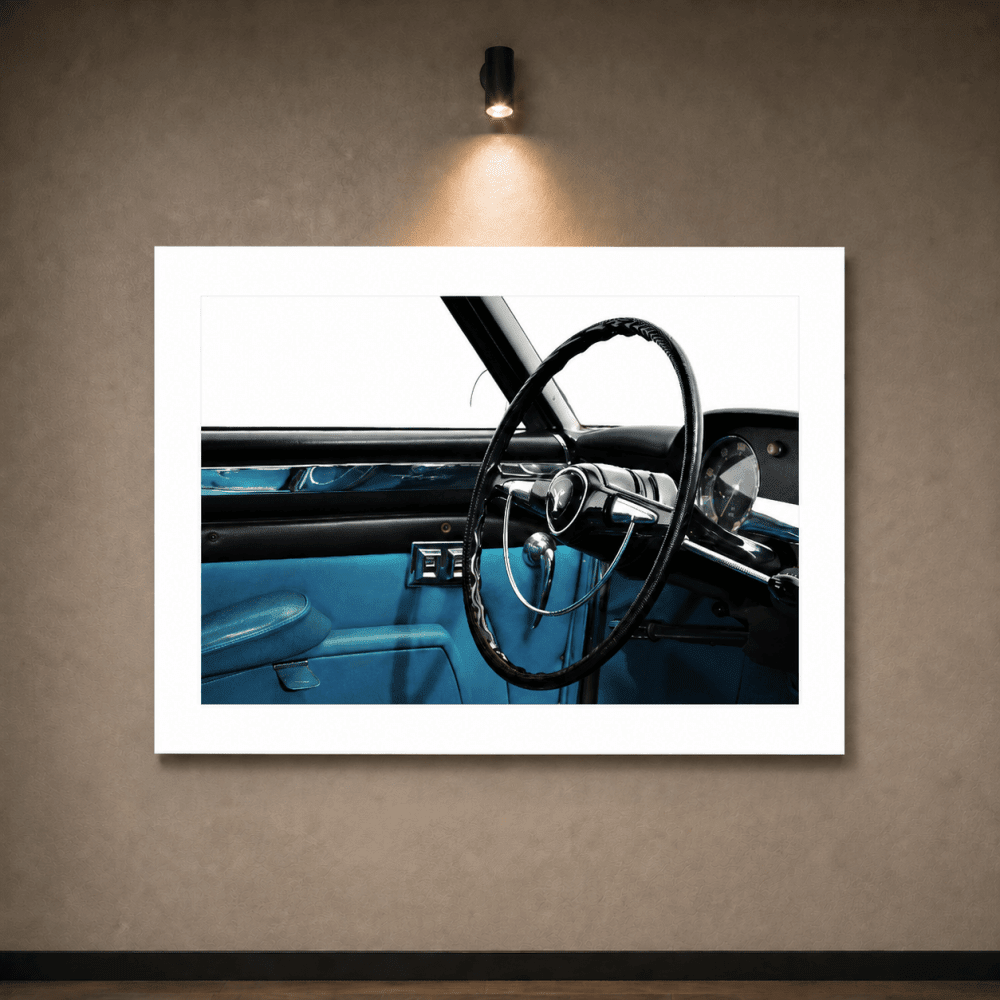
Observing the Florida II print means looking at an automobile as miniature architecture: the relationship between volumes, visibility, and proportions tells a precise way of understanding modernity.
The value of a rear view
In design, the character of an object often emerges from a less immediate perspective. The rear of the Florida II shows how the connection between surfaces and the definition of the rear contribute to the overall identity. This is why a detail photograph can be as interesting as an image of the entire vehicle.

The shop also offers a print dedicated to the rear view, designed for those who wish to delve into precisely this aspect of the project.
1961: from Farina to Pininfarina
A fundamental step in the personal and corporate story arrives in 1961, when the change of the surname Farina to Pininfarina was authorized. In the same year, Battista entrusted the management of the company to his son Sergio and his son-in-law Renzo Carli, ensuring continuity to his work.
The change of surname has a symbolic value: a name born from the history of a person becomes the shared identity of a family and a company. The subsequent evolution of the group, from the automobile to architecture and product design, can be read as an expansion of that original idea.
The memory of design becomes an object to experience
Archival photographs have a different function from contemporary promotional images. They preserve traces of eras, materials, proportions, and languages, allowing us to compare projects far apart in time. The Pininfarina Heritage prints available in the shop transform this heritage into a selection of objects designed also for work environments and the home.
The product sheets describe Fine Art prints accompanied by a certificate of authenticity and editorial materials dedicated to the subject. The intention is to give context to the image, not just display it. The value for a design enthusiast consists precisely in the possibility of associating a form with its history.
For an architecture studio, a private library, or a professional desk, an archival photograph can become a conversation piece: it does not impose a style, but suggests a culture of design. This is also a way to keep the memory of Pininfarina alive in the present.
A lesson that continues: beauty and responsibility of design
The story of Battista Pinin Farina shows that beauty is not necessarily the result of an added decoration. It can come from a proportional choice, from a constraint interpreted intelligently, from a technology used to improve the experience. The path that unites the Cadillac V16 to the Florida II tells precisely this evolution.
Today, in a landscape where design crosses mobility, environments, products, and services, the principle remains recognizable: to design means to give form to a relationship between people, functions, and imagination. The works of the past are not merely a repertoire of styles to quote, but an invitation to continue to experiment.
Frequently asked questions about Battista Pinin Farina and Pininfarina history
When was Pininfarina founded?
Carrozzeria Pinin Farina was founded in Turin on May 22, 1930, by Battista “Pinin” Farina, initially for the design and construction of special bodies and small series.
Why did the name Farina become Pininfarina?
In 1961, the change of the surname Farina to Pininfarina was officially authorized, as remembered in the company's historical timeline.
What is the meaning of the Cadillac V16 in Pininfarina history?
The 1931 Cadillac V16 is presented in the official shop as the first Pinin Farina project carried out on a non-Italian chassis: an encounter between American engineering and Italian style.
Which automobile did Battista Pinin Farina choose for personal use?
According to the official Pininfarina Heritage documentation, Battista chose the Lancia Flaminia Florida II, a concept presented in 1957.
Are the Heritage prints original vintage photographs?
The prints on sale are Fine Art reproductions of images from the Pininfarina archive, not unique vintage photographs. The product sheets indicate a certificate of authenticity and editorial documentation.
Official sources and further reading
Pininfarina – Heritage and biographies; Pininfarina – The Group; Pininfarina Shop – Cadillac V16; Pininfarina Shop – Florida II; Pininfarina Shop – Florida II rear.